
Growth and production of clones of Hevea brasiliensis (rubber) in experimental plantations in the state of Jalisco, Mexico
Article Sidebar
Main Article Content
Abstract
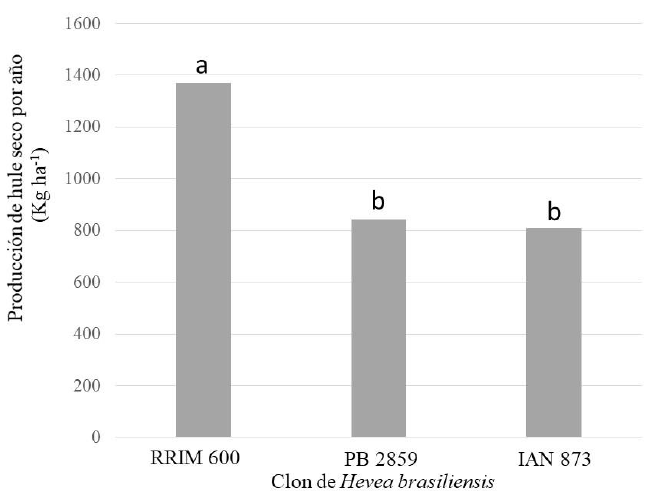
In this document, the survival, growth and production of rubber and latex is estimated in a rubber plantation established in 2012, which is located in Rancho “La Esperanza”, municipality of Talpa de Allende, Jalisco. The evaluation was carried out in 2020 (7.5 years of growth) and corresponded to the first rubber production; three clones IAN 873, PB2859 and RRIM 600 were analyzed. These evaluations seek to select the best genetic materials, based on of its adaptation, notable growth and production, under the environmental conditions with potential in the state of Jalisco. After analyzing the information, the clones had the following results: survival was notable for the three clones, with 100% adaptation. In relation to the dasometric variables (diameter and height), the clones presented very similar values in both variables, according to the analysis of variance there was no significant difference. The average diameters for the trees of the three clones were 17.4 cm and 17.3 cm respectively for the RRIM 600 and PB 2859 clones, and the IAN 873 clone had 15.5 cm. Meanwhile, for the average height, in the same order the clone RRIM 600 10.34 m, PB 2859 with 11.7 m and IAN 873 with 9.93 m. According to the analysis of variance in the production of rubber and latex that was produced in 2020, whose presentation was fresh or liquid, if there was a significant difference between the clones under study, the clone with the highest production turned out to be RRIM 600. with a quantity of 2,055 liters fresh and the production of clones PB 2859 and IAN 873 was 1,398 and 1,320 liters, respectively, these results come from the measurement of 203 trees of clone RRIM 600, 205 trees of clone PB 2859 and 201 trees of the IAN 873 clone. The individual production per tree was 10.12 liters, 6.82 liters and 6.07 liters for the RRIM 600, PB 2859 and IAN 873 clones, respectively. In a complete plantation of 550 trees ha-1, the production per hectare would be 5,566 kg, 3,751 kg and 3,338.5 kg of fresh latex for the three clones mentioned above. For dry latex the production was 1,391.5 kg-1 ha-1 year-1, for RRIM 600 was 940.5 kg ha-1 year-1 for PB 2859 and finally 836 kg ha-1 year-1 for IAN 873.
Article Details

This work is licensed under a Creative Commons Attribution-NonCommercial 4.0 International License.
References
ASOHECA (Asociación de Reforestadores y Cultivadores de Caucho del Caquetá). 1998d. Aprovechamiento del cultivo y beneficio del látex del caucho natural. Programa Nacional de Transferencia de Tecnología. Ministerio de Agricultura y Desarrollo Rural. Colombia. 22 p.
Benavides, S.J. D.; Rubio C. E.A. y Rueda S.A. 2010. Manual para toma de datos de plantaciones forestales. Folleto Técnico Núm. 11. Campo Experimental Centro Altos de Jalisco, CIRPAC-INIFAP. Guadalajara, Jalisco. México. 50 p.
Flores, R.A. y R. Rodríguez M.O. 1992. Clones de hule de alta producción para la zona centro del estado de Veracruz. Folleto Técnico Núm. 2. Área Forestal Campo Experimental El Palmar. Tezonapa, CIRGOC-INIFAP-SARH. Veracruz, México. 14 p.
Hernández, C. J. M. 1990. Clones de alta producción de hule para Tabasco, PB 5/51 y PB 5/63. Campo Experimental Huimanguillo. SARH. INIFAP. CIRGOC. Huimanguillo, Tabasco. 16 p.
Labarre, M. A. y Serier, J. B. 1995. L´hevea. Editions Maisonneuve et Larousse. Paris, Francia. 238 p.
Martínez, R. R., Rojo M. G. E. y Jasso M. J. 2007. Análisis del crecimiento y producción de látex en plantaciones forestales comerciales de hule (Hevea brasiliensis Muell Arg.) en el estado de Oaxaca, México. Revista Ra Ximhai, 3: 565-578.
Moctezuma, L. G., Ortiz C. E., Espinosa G. J. A., Uresti G. J., Vélez I. A., Jolalpa B. J. L., Góngora G. S. F. y Inurreta A. H. D. 2015. Potencial productivo y económico de las plantaciones de hule en el trópico húmedo mexicano. Agronomía Tropical, 65: 7-16.
Ortiz, C. E. 2011. Paquete Tecnológico del Hule (Hevea brasiliensis Muell Arg.): Establecimiento y mantenimiento preoperativo. Campo Experimental El Palmar. Centro de Investigación Regional Golfo Centro-Instituto Nacional de Investigaciones Forestales Agrícolas y Pecuarias. Tezonapa, Veracruz, México. 20 p.
Ortiz, C. E., García C. F., Hernández C. J. M., Diaz F., V. H., García-Valencia L. E., Perez G., J.Z. y Flores H. E. 2017. Caracterización morfológica y molecular de clones de hule [Hevea brasiliensis (Wild. ex A. Juss.) Müll. Arg.]. Cenid-Comef, INIFAP. Ciudad de México, México. Folleto Técnico Núm. 27. 80 p.
Ortiz, C., E. 1995. Informe Técnico de Proyectos. Campo Experimental El Palmar. SARH-INIFAP-CIRGOC. Tezonapa, Veracruz, México. 50 p.
Ortiz, H. E. 2021. Paquete tecnológico del hule Hevea brasiliensis Mull Arg. Establecimiento y mantenimiento preoperativo. Programa estratégico para el desarrollo rural sustentable de la Región Sur-Sureste de México: Trópico Húmedo. Campo Experimental El Palmar-CIRGOC-INIFAP. Tezonapa, Veracruz.
Pérez, M. R., Romero S. M. E., González H. A., Velasco B. E. y Ramírez G. A. G. 2021. Áreas potenciales para establecer plantaciones de hule [Hevea brasiliensis (Willd. ex A. Juss) Müll. Arg.)] en Oaxaca, México. Revista Chapingo Serie Agricultura Tropical, 1: 25–40.
Picón, R. L. 1999. Manual para el cultivo del hule Hevea brasiliensis Müll. Arg. SAGARPA-CMH-INIFAP. Veracruz, México. 103 p.
Quesada, M. I., Aristizábal, G. F. A., Montoya C. D., Chaves C. B. 2009. Evaluación de seis sistemas de sangría para cuatro clones de Hevea brasiliensis (Willd. ex Adr. de Juss) Muell. Arg., en la altillanura colombiana. Revista Colombia Forestal, 12: 37-49.
Rojo, M. G. E., Jasso M. J., Vargas H. J. J., Velázquez M. A. y Palma L. D. J. 2002. Predicción de la producción de látex en plantaciones comerciales de hule (Hevea brasiliensis Mull. Arg.) en Oaxaca, México. Revista Fitotecnia Mexicana, 26: 183–190
Rojo, M. G. E., Martínez R. R. y Jasso M. J. 2011. Parte IV: Producción y rendimiento de plantaciones forestales comerciales de hule en México. In: Libros Técnicos: Serie Forestal El cultivo del Hule en México. Colegio de Postgraduados. Campus Montecillo Programa de Forestal. Universidad Autónoma Indígena de México. p. 231-235
Rubio, C.E.A.; Benavides S. J. D.; Rueda, S. A.; De La Mora O. C. y Orozco G. G. 2010. Evaluación del desarrollo de teca y melina en plantaciones forestales en Sauta, Nayarit. Folleto Técnico Núm. 9. Campo Experimental Centro Altos de Jalisco. CIRPAC-INIFAP. Tepatitlán de Morelos, Jal. México. 96 p.
Rueda, S.A., Sáenz R. J. T., Muñoz F. J. H., Ramírez O. G., y Molina C. A. 2016. Guía técnica para el establecimiento y manejo de plantaciones del cultivo del hule (Hevea brasiliensis) en Jalisco y Nayarit. Folleto Técnico No. 2. Campo Experimental Centro Altos de Jalisco. Tepatitlán de Morelos, Jalisco, México 52 p.
Ruíz, C. J. A., I. J. González A., V. Serrano A., G. Medina G. y G. Díaz P. 2012. Estadísticas climatológicas básicas del Estado de Nayarit (Periodo 1961-2003). Campo Experimental Centro Altos de Jalisco-Centro de Investigación Regional Pacífico Centro- INIFAP. Tepatitlán de Morelos, Jalisco.153 p.