
Forage production and nutritional value of silage of safflower (Carthamus tinctorius L.) varieties harvested at four phenological stages
Article Sidebar
Main Article Content
Abstract
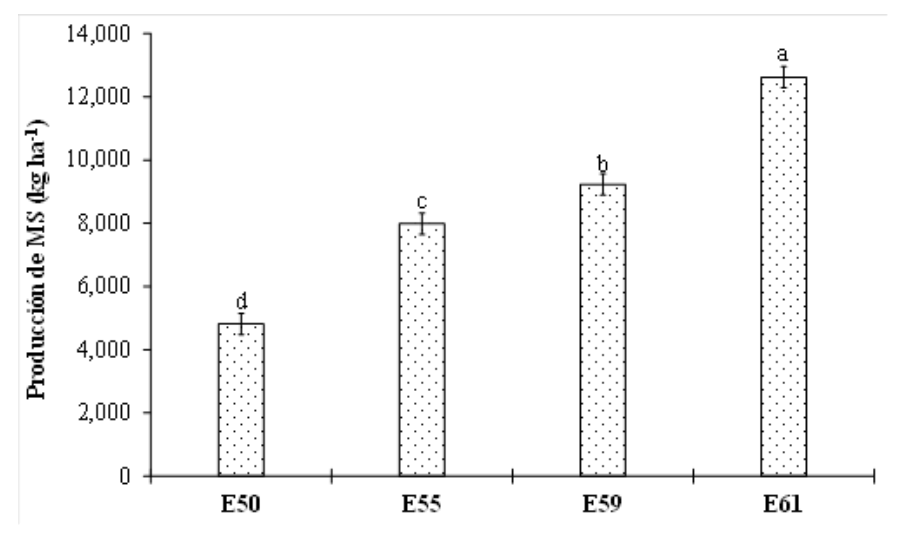
The aim was to study the forage yield and nutritional value of four safflower varieties harvested in four phenological stages. A completely randomized block design with a 4×4 factorial arrangement was used to evaluate two spineless varieties (FORRCART 2020 and Selkino) and two spiny varieties (Gila and Guayalejo) harvested at the beginning of capitulum formation (E50), capitulum clearly separated from the younger leaves (E55), distinguishable medium and intermediate external bracts (E59), and beginning of flowering (E60). Forage yield and nutritional value of the silage were determined in terms of crude protein (CP), neutral detergent fiber (NDF), acid detergent fiber (ADF), net energy for lactation (NEL), and in situ NDF and dry matter (DM) digestibility. The variety FORRCART 2020 had a DM yield similar to Gila and Guayalejo, which yielded more than Selkino. Dry matter yield increased as the phenological stage progressed from E50 to E61. The interaction between variety × harvest stages modified the nutritional value and the NDF digestibility of silage. Silage CP content of all varieties was reduced when maturity advanced from E50 to E61, but FORRCART 2020 presented the greatest decrease from E59. Similarly, the silage of the FORRCART 2020 variety had the largest drop of NEL in E61. Silage NDF and ADF concentrations were higher in all varieties harvested in E61. The NDF digestibility was higher in the Selkino silage harvested at E50, but equal to other varieties harvested in the first three stages. Silage DM digestibility was different by the harvest stage, indicating a reduction of this as the crop's maturity progressed from E50 to E61. The spineless FORRCART 2020 variety had the same forage yield as the spiny varieties and the best silage nutritional value when harvested between E50 and E55.
Article Details

This work is licensed under a Creative Commons Attribution-NonCommercial 4.0 International License.
References
Cazzato, E., Laudadio, V., Corleto, A., Tufarelli, V. 2011. Effects of harvest date, wilting and inoculation on yield and forage quality of ensiling safflower (Carthamus tinctorious L.) biomass. Journal of the Science of Food and Agriculture. 91:2298-302. https://doi.org/10.1002/jsfa.4452
Danieli, P.P., Primi, R., Ronchi, B., Ruggeri, R., Rossini, R., Puglia, Del S., Cereti, C. F. 2011. The potential role of spineless safflower (Carthamus tinctorius L. var. inermis) as fodder crop in central Italy. Italian Journal of Agronomy. 6:e4. https://doi.org/10.4081/ija.2011.e4
Flemmer, A.C., Franchini, M.C., Lindström, L.I. 2015. Description of safflower (Carthamus tinctorius L) phenological growth stages according to the extended BBCH scale. Annals of Applied Biology. 166:331-339.
https://doi.org/10.1111/aab.12186
Kung, L. Jr., Shaver, R.D, Grant, R.J., Schmidt, R.J. 2018. Silage Review: Interpretation of chemical, microbial, and organoleptic components of silage. Journal of Dairy Science. 101:4020-4033. https://doi.org/10.3168/jds.2017-13909
Landau, S., Friedman, S., Brenner, S., Bruckental, I., Weinberg, Z.G., Ashbell, G., Hen, Y., Dvash, L., Leshem, Y. 2004. The value of safflower (Carthamus tinctorius) hay and silage grown under Mediterranean conditions as forage for dairy cattle. Livestock Production Science. 88:263-271. https://doi.org/10.1016/j.livprodsci.2003.11.011
Landau, S., Molle, G., Fois, N., Friedman, S., Barkai, D., Decandia, M., Cabiddu, A., Dvash, L., Sitzia, M. 2005. Safflower (Carthamus tinctorius L.) as a novel pasture species for dairy sheep in the Mediterranean conditions of Sardinia and Israel. Small Ruminant Research. 59:239-249. https://doi.org/10.1016/j.smallrumres.2005.05.008
Maas, E.V., Poss, J.A. Hoffman, G.J. 1986. Salt Tolerance of Plants. Applied Agricultural Research, 1, 12-26. Nair, J., Yu Christensen, D.P., Beettie, A.D., McAllister, T., Damiran, D., Preston, N., Fuhr, L., McKinnon, J.J. 2016. A nutritional evaluation of common barley varieties grown for silage by beef and dairy producers in western Canada. Canadian Journal of Animal Science. 96:598– 608. https://doi.org/10.1139/cjas-2016-0032.
NRC. 2001. Nutrient requirements of dairy cattle. 7th rev. ed. Natl. Acad. Press, Washington, DC.
Ochoa-Espinoza, X.M., Montoya-Coronado, L., Reta-Sánchez, D.G., Borbón-Gracia, B., Aguilera-Molina, N.A., AvilaCasillas, E., Cota-Barreras, C.I. y Cano-Ríos, P. 2021. FORRCART 2020, nueva variedad de cártamo forrajero en México. Revista Fitotecnia Mexicana. 44:275-277. DOI: https://doi.org/10.35196/rfm.2021.2.275
Ochoa-Espinoza, X.M., Reta-Sánchez, D.G., Cano-Ríos, P., Sánchez-Duarte, J.I., Ochoa-Martínez, E., García-Martínez, J.E., Reyes-González, A. y Quiroga-Garza, H.M. 2022. Rendimiento y valor nutritivo de cereales y cártamo forrajero en la Comarca Lagunera. Biotecnia. Volumen XXIV, No. 2. 142-148. DOI: https://doi.org/10.18633/biotecnia.v24i2.1620
Peiretti, P.G. 2009. Effects of growth stage on chemical composition, organic matter digestibility, gross energy and fatty acid content of safflower (Carthamus tinctorius L.). Livestock Research for Rural Development, Volume 22, Article #206. http://www.lrrd.org/lrrd21/12/peir21206.htm
Reta, S.D.G., Serrato, C.J.S., Quiroga, G.H.M., Gaytán, M.A., Figueroa, V.U. 2017. Secuencias de cultivo alternativas para incrementar el potencial forrajero y productividad del agua. Revista Mexicana Ciencias Pecuarias. 8:397-406. https://doi.org/10.22319/rmcp.v8i4.4645
SAS Institute. 2013. The SAS System for Windows, Release 9.4. Statistical Analysis Systems Inst., Cary, NC.
Seven, P.T., Çerçi Í.H. 2006. Relationship between nutrient composition and feed digestibility determined with enzymatic and nylon bag (in situ) techniques in feed sources. Bulgarian Journal of Veterinary Medicine. 9:107-113.
Stanford, K., Wallins, G.L., Lees, B.M., Mundel, H.-H. 2001. Feeding value of immature safflower forage for dry ewes. Canadian Journal of animal Science. 81:289-292. https://doi.org/10.4141/A00-090.
Weinberg, Z.G., Ashbell, G., Hen, Y., Leshem, Y., Landau, Y.S., Brukental, I. 2002. A note on ensiling safflower forage. Grass Forage Science. 57:184-187.
West, J.W., Hill, G.M., Gates, R.N., Mullinix, B.G. 1997. Effects of dietary forage source and amount of forage addition on intake, milk yield, and digestion for lactating dairy cows. Journal of Dairy Science. 80:1656-1665. https://doi.org/10.3168/jds.S0022-0302(97)76097-1