
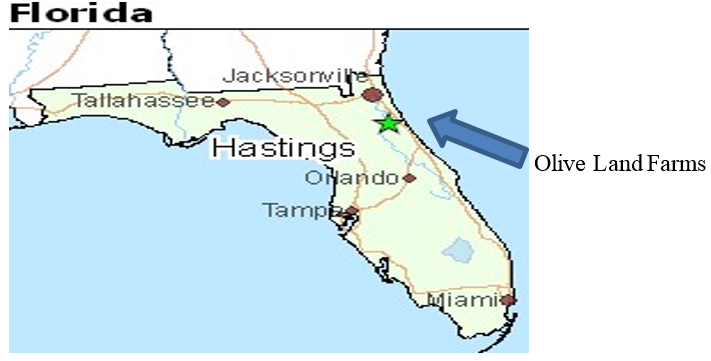
Proposal for measures to mitigate damage due to waterlogging in olive plantations on the Olive Land Farms farm in the State of La Florida
Article Sidebar
Main Article Content
Abstract
The olive tree crop has demonstrated resistance to changes in some climatic variables; it can obtain satisfactory production in relatively adverse edaphoclimatic, landscape, and management circumstances. The purpose of this research is to propose measures for the management of olive trees in waterlogging conditions at Olive Land Farms, Florida, USA. For data collection, a diagnosis of the area under study was applied to identify the current state of the olive grove, which was subjected to periods of waterlogging. The area was diagnosed to analyze the waterlogging situation in the plantation; the variables analyzed were variety, plant condition, and height. To determine the relationship between the variety and the state of the plant, a Chi2 analysis was carried out, and a variety-plant height, one-factor analysis of variance was carried out. Statistical differences between means were identified using Tukey's post hoc test (p<0.05). The result of the diagnosis revealed that there is affectation caused by the period of waterlogging to which the plants were subjected and that there is no relationship between the varieties and the state of the plants, but a relationship was observed with respect to height and variety. Measures were proposed, such as the creation of drainage systems, execution of appropriate cultural work, selection of species and varieties with greater resistance to flooding, and maintenance of a good phytosanitary state of the plantations, as well as the creation of controlled temporary flooding zones.
Article Details

This work is licensed under a Creative Commons Attribution-NonCommercial 4.0 International License.
References
Balam, A, (2023). Características de los Olivos Arbequinas. Recuperado de https://balam.es/
Barranco, Navero D; Fernández, Escobar R; Rallo, Romero L. (2017). El cultivo del olivo 7ª ed. Editorial Mundi-Prensa.
Barranco, Navero D. (2008). Variedades y patrones. In: Barranco, D.; Fernández-Escobar, R.; Rallo, L. eds. El cultivo del olivo. 6a. ed. Madrid, Mundi-Prensa. pp. 84-86.
Bernal Martínez, J. (2017). Caracterización morfológica y molecular de variedades italianas de olivo (Olea europaea L.) instaladas en el jardín de introducción de INIA Las Brujas. Tesis de Doctorado. Facultad de Agronomía, Universidad de la Republica. Montevideo – Uruguay.
Camacho Alonso, G. (2019). efectos fisiológicos (Ensayo en Carpio del Tajo-Toledo) y espectrales (Ensayo en Chozas de Canales-Toledo) de diferentes dosis de riego deficitario en olivar superintensivo (Cv. Arbequina). Universidad Politécnica de Madrid Escuela Técnica Superior de Ingeniería Agronómica Alimentaria y de Biosistemas. Universidad Politécnica de Madrid. Disponible en: https://oa.upm.es/56916/1/TFG_GEMA_MARIA_CAMAC HO_ALONSO.pdf
Díaz, C.; Moral, J.; Barranco, D.; Rallo, L. (2016). Genetic diversity and conservation of olive genetic resources. In: Ahuja, M. R.; Mohan Jain, S. eds. Genetic diversity and erosion in plants, sustainable development and biodiversity. s.l., Springer. pp. 337-356.
Doménech Martínez, S., (2020). Estrategias de adaptación del olivar de la comarca de los serranos (valencia) frente al cambio climático. Universitat Politècnica de València. Escola tècnica superior d’enginyeria agronòmica i del medi natural. Máster en economía agroalimentaria y del medio ambiente.
Dridi, J.; M. Fendri; C. M. Breton & M. Msallem. (2018). Characterization of olive progenies derived from a Tunisian breeding program by morphological traits and SSR markers. Scientia Horticulturae, 236, 127- 136
García Ruiz, R Torrús C y Calero G (2020). El olivar y su adaptación al cambio climático. Disponible en: file:///H:/Grandes-cultivos/Articulos/302564-El-olivar-y-suadaptacion-al-cambio-climatico.html.
Grijalva-Contreras, R.L., Macías-Duarte, R., López-Carvajal, A., & Robles Contreras, F. (2009). Productividad de cultivares de olivo para aceite (olea europea l.) bajo condiciones desérticas en sonora. Biotecnia, 11(2), https://doi.org/10.18633/bt.v1 1i2.60.
Guerrero García, A. (2003). Implantación del olivar. Nueva olivicultura. 5a . ed. rev. y ampl. Madrid, Mundi-Prensa. 304 p.
León, L.; D. Casanova; J. Palma & J. González. (2021). Caracterización agromorfológica de plantas madre del banco de germoplasma de “olivo“ Olea europaea (Oleaceae) en la región Tacna. Arnaldoa 28(3): 593-612 doi: http://doi.org/10.22497/arnaldoa.283.28307
Lorite IJ, Gabaldón-Leal C, Santos C, Cruz-Blanco M, León L, Porras R, Belaj A, de la Rosa R. (2019). Impacto del cambio climático sobre la agricultura andaluza: Olivar. Instituto de Investigación y Formación Agraria y Pesquera. Consejería de Agricultura, Pesca y Desarrollo Rural. Junta de Andalucía.
Penco, JM. (2019). Olivar y Cambio Climático: Impacto del Cultivo del Olivo sobre el Cambio Climático. Efecto del Cambio Climático sobre la estabilidad del mercado del aceite de oliva en España. Jornada Olivar y Cambio Climático. Beja Portugal.
Rossi, L. (2023). Estudio de las aceitunas de la Florida para la producción comercial a pequeña escala. Rev. Oleoteca. Disponible en :https://www.oleorevista.com/textodiario/mostrar/4202881/uf-ifas-prueba-aceitunas-floridadeterminar-posible-industria-comercial
Salgado, C A ; Avilés C D;. Martín, A D; Otero Cabeza D; Prieto, LI; González, OJ; Soler, G V. (2019). Guías de adaptación al riesgo de inundación: explotaciones agrícolas y ganaderas. Ministerio para la Transición Ecológica Secretaría General Técnica Centro de ublicaciones. Catálogo de Publicaciones de la Administración General del Estado: http//publicacionesoficiales.boe.es NIPO: 638-18028-4. Disponible en: file:///D:/Olivos/guia-adaptacion-alriesgo-inundacion-explotaciones-agricolasganaderas_tcm30-503727.pdf
Santos E, Orestes., Valdés Reinoso, R. H., & Castillo Edua, B. R. (2024). Cultivo de Olivo en la Florida, una alternativa para la adaptación al cambio climático. Avances, 26(1), 72-90. http://avances.pinar.cu/index.php/publicaciones/article/view/805
Savé, R. (2016). Medidas para la adaptación al cambio climático en el olivar. Olivar y cambio climático. Jornada Olivar y Cambio Climático. Ministerio de Agricultura Pesca y Alimentación.
Oleas G, (2023). Cuanto tarda en crecer un olivo en el mediterráneo, Disponible en https://www.ginartoleas.com
Tapia C, F; Ibacache, F; Astorga, M. (2002). Manual del cultivo del olivo. Requerimientos de Clima y Suelo. Disponible en: file://C:/Users/Desktop/Olivos/NR30540.pdf
Terrasa, D. (2019). Florida: geografía física. La Guía, Geografía. Disponible en: https://geografia.laguia2000.com/geografiaregional/florida-geografia-fisica.
United States National Arboretum. Florida Hardiness Zones. St Johns River Water Management District. Consultado el 11 de marzo de 2023.