
Life cycle of Lampyridae and planning mismatch in peri-urban interfaces of northwestern Argentina
Article Sidebar
Main Article Content
Abstract
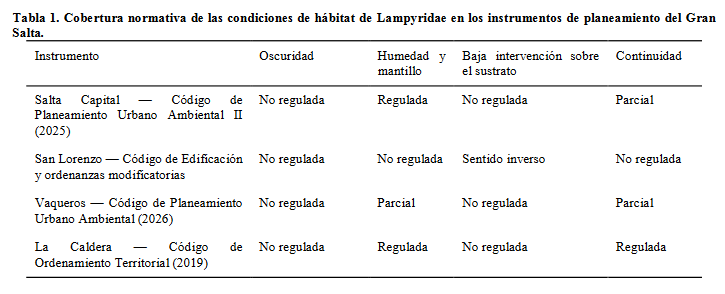
Territorial planning in peri-urban interfaces primarily regulates land through occupancy, building intensity, setbacks, and zoning, whereas ecological processes depend on conditions operating across different spatial and temporal dimensions. This study examines that mismatch in the Greater Salta agglomeration, Argentina, using the family Lampyridae as a focal taxon because of its extended larval stage and its simultaneous dependence on edaphic, light, and connectivity conditions. A qualitative case-study design was applied. Four habitat conditions were derived from the ecological literature: darkness during the reproductive period, soil moisture and leaf-litter persistence, low substrate disturbance, and connectivity between habitat fragments. The regulatory instruments currently in force in Salta Capital, San Lorenzo, Vaqueros, and La Caldera were then examined through structured content analysis using a double-entry matrix and four regulatory-coverage categories. Of the sixteen cells analyzed, three were classified as regulated, three as partially regulated, one as regulated in the opposite direction, and nine as unregulated. None of the four municipalities includes specific environmental regulation of nocturnal darkness. The findings indicate that the mismatch is not explained solely by jurisdictional fragmentation, but also by the limited capacity of planning instruments to represent ecological conditions distributed across space and whose effects may become apparent beyond the moment of project approval. The study proposes incorporating the life cycle of focal species as a complementary unit for environmental planning.
Article Details

This work is licensed under a Creative Commons Attribution-NonCommercial 4.0 International License.
References
Cumming, G.S., Cumming, D.H.M., Redman, C.L. 2006. “Scale mismatches in social-ecological systems: Causes, consequences, and solutions”. Ecology and Society, 11(1): 14, ISSN: 1708-3087, DOI: 10.5751/ES-01569-110114 Folke, C., Pritchard, L., Berkes, F., Colding, J., Svedin, U. 2007. “The problem of fit between ecosystems and institutions: Ten years later”. Ecology and Society, 12(1): 30, ISSN: 1708-3087, DOI: 10.5751/ES-02064-120130
Gaston, K.J., Duffy, J.P., Bennie, J. 2015. “Quantifying the erosion of natural darkness in the global protected area system”. Conservation Biology, 29(4): 1132-1141, ISSN: 0888-8892, https://doi.org/10.1111/cobi.12462
Hölker, F., Wolter, C., Perkin, E.K., Tockner, K. 2010. “Light pollution as a biodiversity threat”. Trends in Ecology & Evolution, 25(12): 681-682, ISSN: 0169-5347, DOI: 10.1016/j.tree.2010.09.007
Khattar, G., Vaz, S., Braga, P.H.P., Macedo, M., Silveira, L.F.L. 2022. “Life history traits modulate the influence of environmental stressors on biodiversity: The case of fireflies, climate and artificial light at night”. Diversity and Distributions, 28(9): 1820-1831, ISSN: 1366-9516, https://doi.org/10.1111/ddi.13584
Lewis, S.M., Wong, C.H., Owens, A.C.S., Fallon, C., Jepsen, S., Thancharoen, A., Wu, C., De Cock, R., Novák, M., López-Palafox, T., Khoo, V., Reed, J.M. 2020. “A global perspective on firefly extinction threats”. BioScience, 70(2): 157-167, ISSN: 0006-3568,
https://doi.org/10.1093/biosci/biz157
Lewis, S.M., Jusoh, W.F.A., Walker, A.C., Fallon, C.E., Joyce, R., Yiu, V. 2024. “Illuminating firefly diversity: Trends, threats and conservation strategies”. Insects, 15(1): 71, ISSN: 2075-4450, https://doi.org/10.3390/insects15010071
Longcore, T., Rich, C. 2004. “Ecological light pollution”. Frontiers in Ecology and the Environment, 2(4): 191-198, ISSN: 1540-9295, DOI:10.1890/1540-9295(2004)002[0191:ELP]2.0.CO;2
McNeil, D.J., Goslee, S.C., Kammerer, M., Lower, S.E., Tooker, J.F., Grozinger, C.M. 2024. “Illuminating patterns of firefly abundance using citizen science data and machine learning models”. Science of the Total Environment, 929: 172329, ISSN: 0048-9697, DOI: 10.1016/j.scitotenv.2024.172329
Ministerio del Medio Ambiente de Chile, 2023. Establece norma de emisión de luminosidad artificial generada por alumbrados de exteriores. no. Decreto Supremo N.º 1/2022, Santiago, Chile: Diario Oficial de la República de Chile, Available: https://www.bcn.cl/leychile/navegar?i=1197027, [Consultado: septiembre 7, 2026].
Municipalidad de La Caldera, 2019. Código de Ordenamiento Territorial. La Caldera, Salta, Argentina: Municipalidad de La Caldera, Available: https://municipalidaddelacaldera.gob.ar/sites/default/files/c.o .t-la-caldera.pdf, [Consultado: septiembre 7, 2026].
Municipalidad de la Ciudad de Salta, 2025. Código de Planeamiento Urbano Ambiental II. no. Ordenanza N.º 16.486/25, Salta, Argentina: Municipalidad de la Ciudad de Salta, Available: https://municipalidadsalta.gob.ar/planificacion-territorial-ycatastro/, [Consultado: septiembre 7, 2026].
Municipalidad de la Villa de San Lorenzo, 2020a. Código de Edificación de la Municipalidad de San Lorenzo. no. Ordenanza N.º 2.034/2020, San Lorenzo, Salta, Argentina: Municipalidad de San Lorenzo, Available: https://munisanlorenzo.gob.ar/2020/07/30/codigo-deedificacion-vigente/, [Consultado: septiembre 7, 2026].
Municipalidad de la Villa de San Lorenzo, 2020b. Modificación del Código de Edificación. no. Ordenanza N.º 2.058/2020, San Lorenzo, Salta, Argentina: Concejo Deliberante de San Lorenzo.
Municipalidad de la Villa de San Lorenzo, 2025. Anexo de modificaciones al Código de Edificación. no. Ordenanza N.º
2.522/25, San Lorenzo, Salta, Argentina: Concejo Deliberante de San Lorenzo.
Municipalidad de Vaqueros, 2026. Código de Planeamiento Urbano Ambiental. Plan Urbano Ambiental 2026. Vaqueros, Salta, Argentina: Municipalidad de Vaqueros, Available: https://colarqsalta.org.ar/normativas/edilicias/, [Consultado: septiembre 7, 2026].
Owens, A.C.S., Lewis, S.M. 2018. “The impact of artificial light at night on nocturnal insects: A review and synthesis”. Ecology and Evolution, 8(22): 11337-11358, ISSN: 2045-7758, https://doi.org/10.1002/ece3.4557
Owens, A.C.S., Van den Broeck, M., De Cock, R., Lewis, S.M. 2022. “Behavioral responses of bioluminescent fireflies to artificial light at night”. Frontiers in Ecology and Evolution, 10: 946640, ISSN: 2296-701X, https://doi.org/10.3389/fevo.2022.946640
Provincia de Salta, 1999. Ley de Protección del Medio Ambiente. no. Ley N.º 7.070, Salta, Argentina: Boletín Oficial de Salta, Available: https://boletinoficialsalta.gob.ar/, [Consultado: septiembre 7, 2026].
República Argentina, 2002. Ley General del Ambiente. no. Ley N.º 25.675, Buenos Aires, Argentina: Boletín Oficial de la República Argentina, Available: https://www.argentina.gob.ar/normativa/nacional/ley-2567579980/texto, [Consultado: septiembre 7, 2026].
Sordello, R., Busson, S., Cornuau, J.H., Deverchère, P., Faure, B., Guetté, A., Hölker, F., Kerbiriou, C., Lengagne, T., Le Viol, I., Longcore, T., Moeschler, P., Ranzoni, J., Ray, N., Reyjol, Y., Roulet, Y., Schroer, S., Secondi, J., Valet, N.,
Vanpeene, S., Vauclair, S. 2022. “A plea for a worldwide development of dark infrastructure for biodiversity: Practical examples and ways to go forward”. Landscape and Urban Planning, 219: 104332, ISSN: 0169-2046,
DOI:10.1016/j.landurbplan.2021.104332
Young, O.R. 2002. The institutional dimensions of environmental change: Fit, interplay, and scale. Cambridge, Massachusetts, USA: MIT Press, 221 p., ISBN: 0-26274024-9.